We use the term "AI-native" on our own homepage, so we owe you an honest explanation of what we actually mean by it. "AI-powered" has become one of those phrases that gets added to everything now, and it can mean very different things depending on who is using it. We want to be specific about what it means to us.
That's not what we mean. And the difference matters, especially if you are figuring out how to test your software better.
There's a spectrum, and it helps to name it
Not all AI usage in testing is created equal. We think about it as three distinct levels:
| Level | What AI does | Human role | Analogy |
|---|---|---|---|
| AI-Assisted | Helps you type faster, suggests what to write next | Does all the work, AI just speeds things up | Spellcheck |
| AI-Augmented | Writes first drafts of tests from your requirements | Reviews, fixes, and maintains everything | Junior hire that needs supervision |
| AI-Native | Reads requirements, writes tests, fixes broken ones, runs everything, reports back | Makes the hard calls on edge cases | A testing team with a senior lead |
There is nothing wrong with AI-assisted. It is genuinely useful. But it is worth understanding where it sits on the spectrum, because the jump to AI-native is a bigger shift than most people expect.
The real shift happens at the AI-native level: the entire workflow is designed around what AI is good at. Humans are still essential, but their role changes from doing the work to judging the work. As the World Quality Report has noted year after year, the biggest bottleneck in QA is not a lack of tools. It is a lack of time and people. AI-native approaches tackle that head-on.
What this looks like in practice
Here's what happens when a Jira ticket lands in a Kintova-managed project:
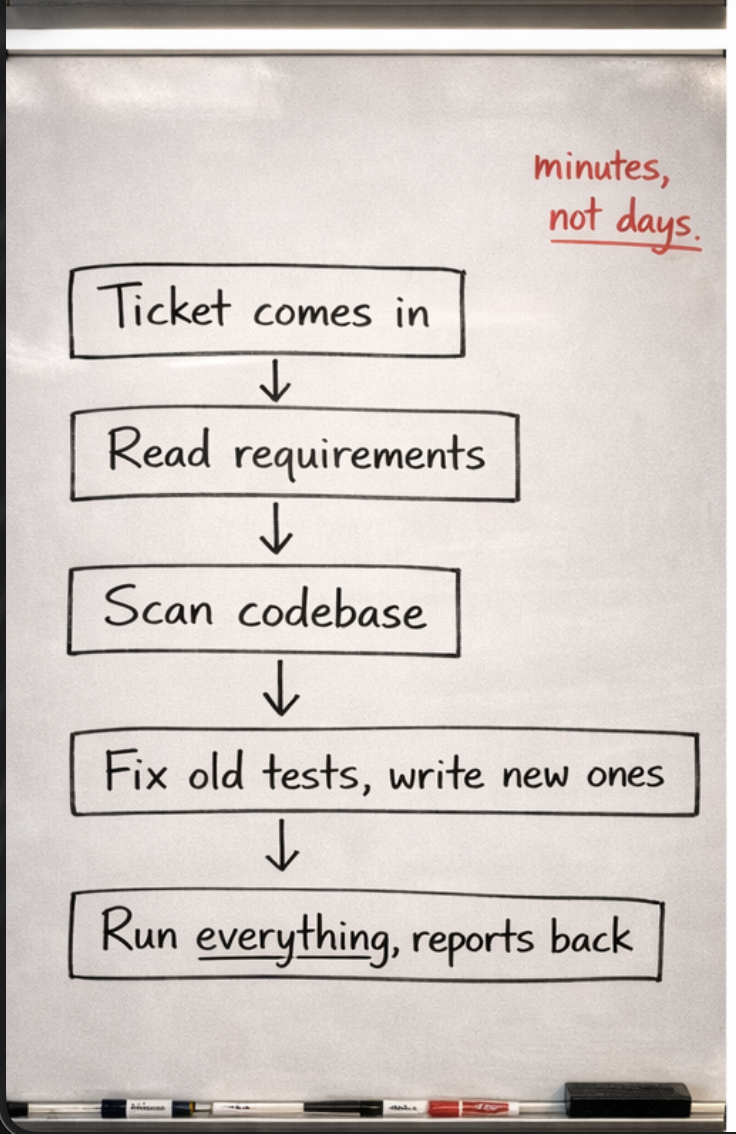
The whole thing takes minutes. Nobody had to write a test or manually kick anything off. Someone on the team reviews what the AI produced, gives the thumbs up, and moves on.
This isn't theoretical. This is the workflow we run for clients today. It mirrors what Google's engineering teams have described as the future of testing. In their Software Engineering at Google research, they emphasise that sustainable testing at scale requires automation that goes beyond just running scripts. It requires systems that understand what to test and why.
What we have actually seen work (and not work)
We are not going to pretend we have all the answers. We have been doing this long enough to know where AI genuinely saves time and where it creates a false sense of security. Here is what we have found so far.
AI is excellent at the work nobody wants to do. Scanning a large codebase to figure out what changed and what it might affect. Writing hundreds of test variations that no person would have the patience for. Updating tests automatically when the interface changes but the underlying behaviour has not. Running at 3am without complaint. And it never forgets. The edge case it caught last month, it will catch again next month.
But there are things it simply cannot do. It does not know that a particular edge case cost your company R2 million last year. It does not have that gut feeling when a user flow just seems off. It cannot tell you whether a passing test actually means anything, because sometimes a green light is meaningless. And it has no sense of which problems are worth shipping around and which ones need to stop a release.
AI handles the 80% that is repetitive. Humans handle the 20% that requires judgment.
Why this matters for teams that aren't Google-sized
If you're working in a team where QA is one person's job (on top of their other responsibilities), or where testing happens "when there's time", AI-native testing isn't about replacing anyone. It's about giving your small team the kind of coverage that used to require six to eight dedicated testers.

This is especially relevant in South Africa, where McKinsey's research on African tech highlights that smaller teams need to do more with less. Budget constraints are real. Hiring a full QA team is not always an option. But the software still needs to work, and your customers do not care whether you had the budget for proper testing.
AI-native testing changes the economics. Gartner has predicted that by 2027, AI-augmented testing will reduce manual test effort by up to 70%. We think the number is even higher when the workflow is AI-native from the start, because you're not retrofitting AI into a manual process, you're building around it.
A simple way to tell the difference
We use a straightforward test when talking to clients. Ask yourself: if you switched off the AI tomorrow, what would happen?
If things would just get slower, that is AI-assisted. Helpful, sure. But your process would survive without it.
If things would fall apart, if there is genuinely no way to do what you are doing without the AI, that is AI-native.
For us at Kintova, there is no manual fallback. Our agents check requirements for gaps before development starts, analyse code changes when a pull request is opened, generate and run tests, produce compliance evidence, and monitor production after deployment. Take the AI away and the whole thing stops. That is not because we are trying to be clever with labels. It is because quality at the speed modern development demands requires checks at every stage of delivery, not just at the end.
Further reading: The World Quality Report tracks industry trends in quality engineering. Google's Software Engineering at Google covers testing philosophy at scale. And Martin Fowler's test pyramid is still a solid foundation for thinking about how to layer your testing.